What is a Document Controller? Roles, Responsibilities and Skills (2026)
In today’s fast-paced industries, where projects generate thousands of drawings, contracts, technical reports, inspection records, and compliance documents, maintaining organised and accurate information is more important than ever. This is where a Document Controller plays a vital role.
Whether it’s a large-scale construction project, an oil and gas facility, a healthcare organisation, or a manufacturing company, document controllers ensure that the right information reaches the right people at the right time. Their work supports project efficiency, regulatory compliance, quality assurance, and informed decision-making.
As organisations continue to adopt digital document management systems and cloud-based collaboration tools, the demand for skilled document controllers is growing rapidly across the UK and worldwide. Employers are increasingly seeking professionals who can manage complex documentation, maintain version control, and ensure compliance with international standards such as ISO 9001.
What is a Document Controller?
A Document Controller is a specialist responsible for managing the complete lifecycle of business and project documentation. Their primary role is to ensure that documents are properly created, reviewed, approved, distributed, updated, stored, and archived in accordance with organisational procedures and industry standards.
Unlike a general administrative role, document control focuses on maintaining the integrity, traceability, and accessibility of information. Every drawing, specification, report, contract, inspection record, and technical document must be accurately controlled to prevent errors, duplication, or the use of outdated information.
Document controllers act as the central point of coordination for documentation between project managers, engineers, architects, consultants, contractors, clients, suppliers, and regulatory authorities. They ensure that all stakeholders have access to the latest approved versions of documents, reducing the risk of costly mistakes and improving collaboration across teams.
Modern document controllers work extensively with Electronic Document Management Systems (EDMS), cloud-based collaboration platforms, and specialised software to organise and monitor thousands of digital files. Their responsibilities extend beyond simple filing, encompassing document workflows, revision tracking, metadata management, access control, audit preparation, and compliance monitoring.
As digital transformation continues across industries, the document controller’s role has evolved into a strategic function that supports operational excellence, quality management, information governance, and regulatory compliance.
What is Document Control?
Document control is the systematic process of managing documents throughout their entire lifecycle. It ensures that information is accurate, current, secure, and available to authorised users whenever required.
An effective document control system typically includes:
- Creating and numbering documents
- Reviewing and approving documentation
- Assigning revision numbers
- Controlling document distribution
- Managing access permissions
- Tracking document history
- Archiving superseded versions
- Retaining records according to legal or contractual requirements
- Securely disposing of obsolete documents
Without proper document control, organisations risk using outdated information, duplicating work, failing audits, breaching regulations, and experiencing costly project delays.
Document Control vs Document Management
Although the terms are often used interchangeably, they represent different concepts.
| Document Control | Document Management |
|---|---|
| Focuses on controlling document versions, approvals, and compliance | Focuses on storing, organising, and retrieving documents |
| Ensures only approved documents are used | Ensures documents are easy to locate and access |
| Supports regulatory compliance and quality assurance | Improves operational efficiency and collaboration |
| Includes revision tracking and audit trails | Includes indexing, categorisation, and storage |
| Commonly used in regulated industries | Used across all business sectors |
In practice, document control forms a critical part of a broader document management strategy. While document management organises information, document control ensures that the information remains reliable, accurate, and compliant throughout its lifecycle.
Why Every Organisation Needs Document Control
Every organisation generates documents that are essential for daily operations, legal compliance, financial reporting, customer service, and project delivery. Without structured document control procedures, businesses face increased risks of errors, miscommunication, and regulatory non-compliance.
Effective document control helps organisations:
- Improve collaboration between departments and project teams
- Prevent the use of outdated or incorrect information
- Maintain compliance with quality management standards
- Support internal and external audits
- Protect confidential and sensitive information
- Reduce duplication of work
- Improve project efficiency and productivity
- Enhance decision-making through reliable documentation
- Maintain complete document traceability
- Preserve organisational knowledge for future projects
In sectors such as construction, engineering, pharmaceuticals, healthcare, and manufacturing, effective document control is often a contractual and regulatory requirement rather than simply a best practice.
Why Are Document Controllers Important?
Behind every successful project is a well-organised system for managing information. Whether constructing a skyscraper, manufacturing medical equipment, delivering renewable energy infrastructure, or managing public sector programmes, organisations rely on accurate documentation to make informed decisions and maintain compliance.
Document Controllers are responsible for ensuring that this information remains organised, accessible, and trustworthy throughout the entire project lifecycle.
Without effective document control, organisations may experience:
- Delays caused by outdated drawings or specifications
- Costly rework due to incorrect document revisions
- Poor communication between stakeholders
- Failed quality or regulatory audits
- Contractual disputes arising from missing documentation
- Loss of critical business information
- Increased legal and financial risks
- Reduced productivity across project teams
By maintaining accurate document records and controlling the flow of information, document controllers help minimise these risks while improving operational efficiency.
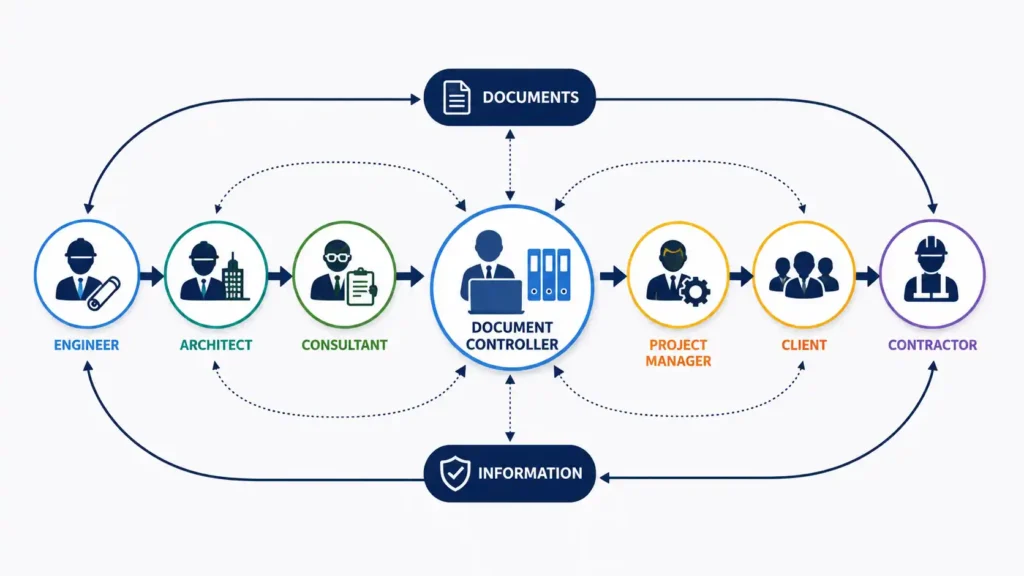
Supporting Successful Project Delivery
Large projects often involve hundreds of stakeholders and tens of thousands of documents. Engineers, architects, consultants, contractors, suppliers, and clients all rely on accurate information to perform their work effectively.
A Document Controller ensures that:
- Everyone works from the latest approved documents.
- Obsolete versions are removed from circulation.
- Project documentation follows established workflows.
- Document revisions are fully traceable.
- Information is distributed to the correct stakeholders at the right time.
This structured approach significantly reduces errors and supports the successful delivery of complex projects.
Ensuring Regulatory and Quality Compliance
Many industries operate under strict legal, contractual, and quality requirements. Standards such as ISO 9001 require organisations to maintain controlled documented information to demonstrate compliance and support continual improvement.
Document Controllers play an essential role by ensuring that documentation:
- Meets organisational standards
- Is reviewed and approved before use
- Remains secure and confidential
- Is retained according to legal requirements
- Can be retrieved quickly during audits or inspections
This helps organisations demonstrate accountability, maintain certifications, and satisfy regulatory authorities.
Supporting Digital Transformation
Modern organisations are replacing paper-based filing systems with cloud-based Electronic Document Management Systems (EDMS) and collaborative digital platforms. As a result, the role of the Document Controller has expanded beyond traditional filing and record-keeping.
Today’s professionals are expected to manage digital workflows, coordinate document approvals, maintain metadata, configure access permissions, and support information governance across multiple systems.
With technologies such as artificial intelligence, Building Information Modelling (BIM), automation, and cloud collaboration becoming increasingly common, document controllers are now key contributors to digital project delivery and organisational efficiency.
Core Responsibilities of a Document Controller
Although responsibilities vary by industry and organisation, most document controllers perform the following essential tasks.
Receiving and Registering Documents
Every document entering or leaving an organisation must be recorded to maintain traceability.
This includes:
- Receiving engineering drawings
- Registering supplier documents
- Logging client correspondence
- Recording subcontractor submissions
- Tracking contracts and specifications
- Assigning document numbers
Each document is typically assigned a unique identification code that allows it to be tracked throughout its lifecycle.
Example
An engineering consultant submits revised structural drawings for a bridge project. The Document Controller logs the submission into the EDMS, assigns the correct revision number, records the submission date, and notifies the project team that a new revision has been received.
Reviewing Document Quality
Before documents are distributed, they must be checked to ensure they comply with organisational requirements.
Typical checks include:
- Correct document numbering
- Naming conventions
- Revision numbers
- Required signatures
- Approval status
- Formatting standards
- Completeness of information
- Metadata accuracy
Document Controllers do not usually approve technical content unless authorised, but they ensure that all required approvals have been completed before distribution.
Managing Version Control
Version control is one of the most important responsibilities of a Document Controller.
Projects often produce multiple revisions of the same document.
For example:
Revision A
↓
Revision B
↓
Revision C
↓
Final Approved Version
If older versions remain in circulation, project teams may accidentally work from outdated information, leading to costly mistakes.
A Document Controller ensures:
- Only the latest approved version is available
- Previous revisions remain archived
- Revision histories are maintained
- Changes are fully traceable
Controlling Document Distribution
After approval, documents must reach the appropriate people.
Distribution may include:
- Engineers
- Architects
- Contractors
- Clients
- Consultants
- Procurement teams
- Quality departments
- Site supervisors
Modern EDMS platforms automatically notify users whenever new revisions become available.
This ensures everyone works from the latest approved information.
Maintaining Electronic Document Management Systems (EDMS)
Most organisations now manage documentation digitally.
A Document Controller is responsible for maintaining systems such as:
- Oracle Aconex
- Microsoft SharePoint
- Autodesk Construction Cloud
- Procore
- Asite
- Viewpoint
- OpenText Documentum
Responsibilities include:
- Uploading documents
- Managing folders
- Updating metadata
- Assigning permissions
- Tracking workflows
- Monitoring document status
- Generating reports
Protecting Confidential Information
Many project documents contain commercially sensitive or confidential information.
Examples include:
- Contracts
- Financial reports
- Design drawings
- Client information
- Intellectual property
- Tender documentation
Document Controllers ensure only authorised personnel can access these documents by implementing appropriate security permissions and access controls.
Preparing Documents for Audits
Internal and external audits require organisations to demonstrate that documentation is properly controlled.
A Document Controller prepares:
- Revision histories
- Approval records
- Distribution logs
- Audit trails
- Archived documents
- Compliance records
This enables auditors to verify that document control procedures are being followed correctly.
Archiving Project Documentation
Once projects are completed, documents must be retained according to legal, contractual, and organisational requirements.
Archiving involves:
- Closing document workflows
- Organising final records
- Securing long-term storage
- Managing retention schedules
- Supporting future retrieval
Proper archiving protects valuable organisational knowledge and ensures information remains available if required years later.
Document Controller Roles and Responsibilities Throughout a Project
The responsibilities of a Document Controller change as a project progresses.
Before a Project Starts
During project mobilisation, document controllers establish the documentation framework.
Typical responsibilities include:
- Creating document numbering systems
- Setting up EDMS folders
- Establishing naming conventions
- Defining document workflows
- Creating document registers
- Configuring user permissions
- Developing document control procedures
A strong document control system established at the beginning significantly reduces problems later in the project.
During Project Execution
This is usually the busiest phase.
Document Controllers manage hundreds or even thousands of documents every week.
Daily activities include:
- Registering incoming documents
- Distributing approved drawings
- Updating revision histories
- Coordinating approvals
- Responding to document requests
- Tracking overdue submissions
- Monitoring workflow progress
- Supporting project meetings
They also communicate regularly with engineers, contractors, suppliers, and project managers to ensure documentation remains accurate and up to date.
During Quality Inspections
Quality assurance teams rely heavily on controlled documentation.
Document Controllers provide:
- Inspection reports
- Material certificates
- Test results
- Calibration records
- Quality plans
- Method statements
Accurate documentation demonstrates compliance with project specifications and quality standards.
During Audits
Auditors frequently request evidence that documents have been controlled correctly.
The Document Controller provides:
- Controlled copies
- Approval records
- Revision histories
- Distribution logs
- Training records
- Retention records
Efficient document control can significantly reduce audit preparation time.
During Project Close-Out
As projects near completion, attention shifts towards final documentation.
Tasks include:
- Collecting final revisions
- Verifying approved documents
- Compiling handover packages
- Organising as-built drawings
- Closing document registers
- Archiving project records
Complete and accurate close-out documentation is often a contractual requirement before final project acceptance.
The Complete Document Control Process Explained
Effective document control follows a structured workflow that ensures every document is properly managed throughout its lifecycle.
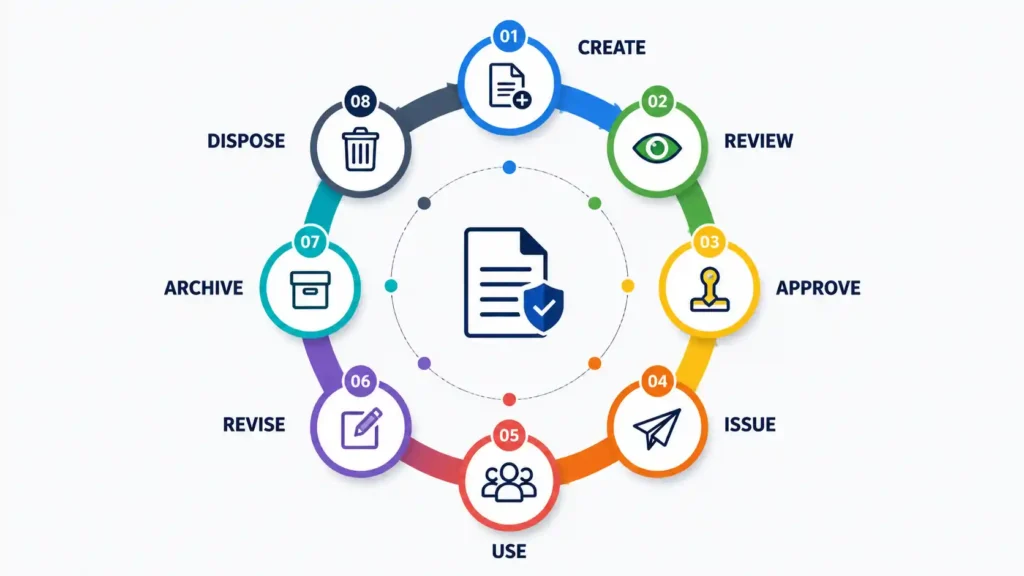
Step 1: Document Creation
A document is created by an engineer, architect, consultant, contractor, or another authorised contributor.
Examples include:
- Technical drawings
- Inspection reports
- Method statements
- Contracts
- Specifications
Step 2: Document Registration
The document receives:
- Unique document number
- Title
- Revision code
- Author details
- Submission date
- Metadata
It is then entered into the document register or EDMS.
Step 3: Review
Relevant stakeholders review the document for:
- Technical accuracy
- Completeness
- Compliance
- Formatting
- Organisational standards
Any required changes are returned to the author.
Step 4: Approval
Once all comments have been addressed, authorised personnel formally approve the document.
Only approved documents should enter operational use.
Step 5: Distribution
Approved documents are distributed to relevant stakeholders.
Examples include:
- Construction teams
- Procurement departments
- Clients
- Consultants
- Site supervisors
- Quality inspectors
Controlled distribution ensures everyone works from the same approved information.
Step 6: Revision Control
Projects frequently require updates.
Whenever changes occur:
- New revision numbers are assigned.
- Previous versions are archived.
- Revision histories are updated.
- Stakeholders receive notifications.
This prevents outdated documents from being used.
Step 7: Storage
Approved documents are securely stored within the EDMS.
Storage procedures typically include:
- Folder classification
- Metadata indexing
- Backup procedures
- Access permissions
- Security controls
Step 8: Retrieval
Authorised users can quickly locate documents using:
- Document numbers
- Keywords
- Project codes
- Revision numbers
- Categories
Efficient retrieval saves significant project time.
Step 9: Archiving
When documents become inactive, they are archived according to retention policies.
Archived documents remain available for:
- Legal purposes
- Audits
- Future maintenance
- Historical reference
Step 10: Secure Disposal
After retention periods expire, obsolete documents are securely destroyed in accordance with organisational policies and applicable regulations.
The Document Lifecycle at a Glance
Document Created
│
▼
Registered in EDMS
│
▼
Reviewed
│
▼
Approved
│
▼
Distributed
│
▼
Used During Project
│
▼
Revised (if required)
│
▼
Stored Securely
│
▼
Archived
│
▼
Disposed According to Retention Policy
Real-World Example: Document Control in Action
Imagine a construction company building a new hospital. During the project, hundreds of drawings, inspection reports, material approvals, contracts, and safety documents are exchanged every week.
The Document Controller receives revised architectural drawings from the design consultant, verifies that the revision number matches the project register, checks that all required approvals are in place, uploads the files to the EDMS, and distributes the latest approved versions to site engineers, contractors, and project managers. At the same time, the previous revision is archived to ensure no one accidentally works from outdated information.
Later, during a quality audit, the auditor requests evidence showing when the drawing was approved and who received it. Within minutes, the Document Controller retrieves the complete audit trail, including approval records, revision history, and distribution logs. This efficient process helps the organisation demonstrate compliance, avoid costly delays, and maintain confidence in the accuracy of its project documentation.
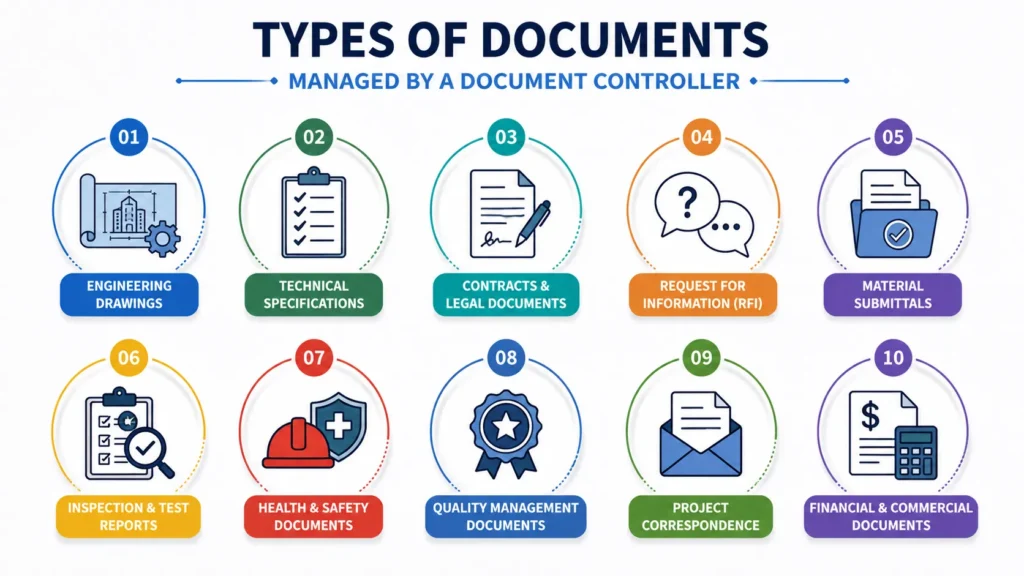
Types of Documents Managed by a Document Controller
One of the primary responsibilities of a Document Controller is managing a wide variety of documents throughout their lifecycle. Depending on the industry and project, a single document controller may oversee hundreds or even tens of thousands of files simultaneously. These documents serve as the official record of a project’s planning, execution, quality assurance, safety, procurement, and compliance activities.
The exact documents vary by industry, but the objective remains the same: to ensure every document is accurate, approved, traceable, and accessible when needed.
| Document Type | Purpose |
|---|---|
| Engineering Drawings | Technical design and construction guidance |
| Technical Specifications | Define project requirements and standards |
| Contracts | Legal agreements between parties |
| RFIs | Request technical clarification |
| Material Submittals | Obtain approval for construction materials |
| Inspection Reports | Verify quality and compliance |
| Safety Documents | Protect workers and ensure legal compliance |
| Quality Documents | Support ISO and quality management systems |
| Project Correspondence | Maintain communication records |
| Financial Documents | Support procurement and commercial management |
Essential Skills Every Document Controller Needs
Successful Document Controllers combine technical expertise with strong organisational and interpersonal skills. Their ability to manage complex information accurately while communicating effectively with multiple stakeholders is essential to project success.
Technical Skills
Document Control Procedures
Understanding structured document workflows, approval processes, and revision management is fundamental.
Professionals should be familiar with:
- Document numbering systems
- Transmittals
- Revision control
- Document registers
- Retention schedules
- Metadata management
Electronic Document Management Systems (EDMS)
Modern organisations expect Document Controllers to be proficient in digital document management platforms.
Experience with systems such as Oracle Aconex, SharePoint, Autodesk Construction Cloud, and Procore is highly valued by employers.
Microsoft Office Skills
Strong skills in Microsoft Office remain essential.
In particular:
- Excel
- Word
- Outlook
- PowerPoint
Excel is widely used for document registers, tracking logs, and reporting.
Understanding Industry Standards
Knowledge of standards such as ISO 9001, ISO 14001, and ISO 45001 helps Document Controllers support organisational compliance and quality management.
Data Accuracy
Attention to detail is one of the profession’s defining characteristics.
Even a minor error in a document number or revision code can lead to costly project delays.
Essential Soft Skills
Organisation
Managing thousands of documents requires exceptional organisational ability.
Document Controllers must prioritise tasks, maintain structured filing systems, and manage competing deadlines efficiently.
Communication
Document Controllers communicate daily with:
- Engineers
- Project Managers
- Clients
- Consultants
- Contractors
- Suppliers
- Auditors
Clear communication helps ensure documentation flows smoothly between stakeholders.
Time Management
Projects operate under strict deadlines.
Document Controllers must process documentation quickly without compromising accuracy.
Problem Solving
Missing approvals, incorrect revisions, or delayed document submissions require proactive problem-solving skills.
Confidentiality
Many project documents contain commercially sensitive information.
Maintaining confidentiality and following organisational security procedures is essential.
Teamwork
Document Controllers work closely with multidisciplinary teams.
Building positive working relationships improves communication and project efficiency.
Best Software Used by Document Controllers
Technology has transformed document control from paper filing to sophisticated digital information management. Employers increasingly expect candidates to be familiar with modern document management platforms.
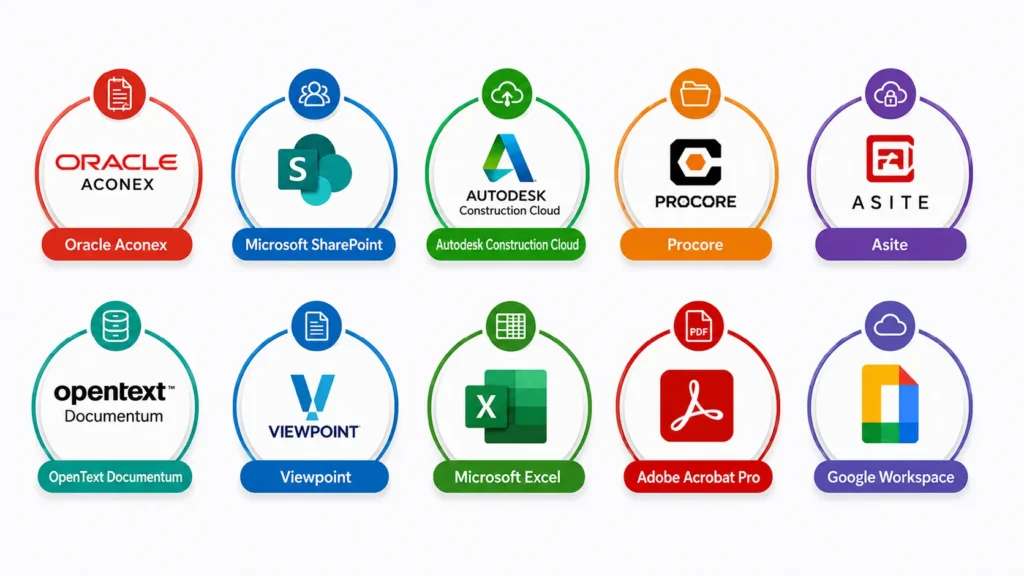
The following software solutions are among the most widely used in the industry.
| Software | Primary Use | Common Industries |
|---|---|---|
| Oracle Aconex | Document control and project collaboration | Construction, Infrastructure |
| Microsoft SharePoint | Document management and collaboration | Corporate, Government |
| Autodesk Construction Cloud | BIM and construction document management | Construction |
| Procore | Construction project management | Construction |
| Asite | Cloud document collaboration | Engineering, Infrastructure |
| OpenText Documentum | Enterprise document management | Pharmaceutical, Government |
| Viewpoint | Construction documentation | Construction |
| Microsoft Excel | Registers and tracking logs | All industries |
| Adobe Acrobat Pro | PDF review and mark-ups | All industries |
| Google Workspace | Collaborative document editing | SMEs and remote teams |
Ready to Start Your Document Control Career?
Build the skills employers value with our Diploma in Document Controller, designed to prepare you for document control roles across construction, engineering, manufacturing, and other industries. If you want to master one of the most in-demand document management platforms, you can also enroll in our Oracle Aconex Professional Training for Document Controller to gain practical, industry-relevant software expertise and enhance your career prospects.
Conclusion
Document Controllers play a vital role in ensuring that project and business documents remain accurate, organised, secure, and compliant throughout their lifecycle. From managing technical drawings and contracts to controlling document revisions and supporting audits, they help organisations improve efficiency, reduce errors, and maintain regulatory compliance across industries such as construction, engineering, manufacturing, healthcare, and energy.
With the growing adoption of digital document management systems and cloud-based collaboration tools, the demand for skilled Document Controllers continues to rise worldwide. If you’re looking to build a stable and rewarding career, gaining the right knowledge, software skills, and a recognised Diploma in Document Controller can provide a strong foundation for success and open doors to opportunities across multiple industries.
Learn complete guide How to Become a Document Controller.