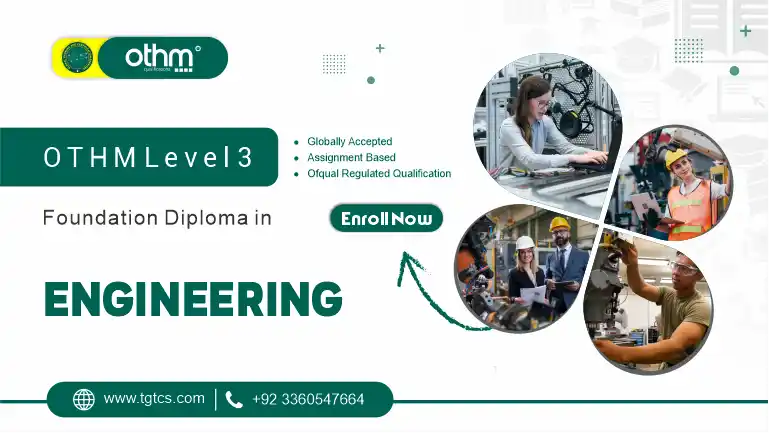
Level 3 Foundation Diploma in Engineering
The Level 3 Foundation Diploma in Engineering is a comprehensive qualification designed to provide learners with a strong introduction to the core principles of engineering. This course is ideal for individuals who want to start a career in engineering or progress to higher technical and vocational qualifications. It equips students with essential theoretical knowledge and practical understanding required to succeed in various engineering disciplines.
This diploma covers key areas such as engineering mathematics, science principles, electrical and mechanical systems, and technical drawing. Learners develop problem-solving, analytical, and practical skills that are essential in real-world engineering environments. The course also focuses on developing an understanding of engineering processes, safety standards, and modern industrial practices used in different engineering sectors.
The Level 3 Foundation Diploma in Engineering provides an excellent pathway for further education and career opportunities in the engineering field. It prepares learners for advanced engineering studies and entry-level technical roles in industries such as mechanical, electrical, civil, and manufacturing engineering. With strong demand for skilled engineers worldwide, this qualification opens doors to a wide range of academic and professional opportunities in the engineering sector.
The Global Training and Certification Services (TGTCS) is Offering this qualification is Association with ICTQual UK
The Level 3 Foundation Diploma in Engineering is a professionally structured qualification designed to provide learners with essential knowledge and practical skills in core engineering principles. It serves as an ideal starting point for individuals who wish to enter the engineering field or progress toward higher technical qualifications. The course builds a strong foundation in engineering concepts, helping learners understand how modern engineering systems and processes operate in real-world environments.
This qualification focuses on developing both theoretical understanding and practical application in areas such as mathematics, science, mechanical systems, electrical principles, and technical drawing. Learners gain problem-solving abilities, analytical thinking, and technical skills that are highly valued in the engineering industry. The Level 3 Foundation Diploma in Engineering consists of 6 mandatory units, with a combined total of 60 credits, 600 hours Total Qualification Time (TQT), and 240 Guided Learning Hours (GLH), ensuring a balanced and structured learning experience.
The learning outcomes of the Level 3 Foundation Diploma in Engineering are designed to ensure that students gain both theoretical knowledge and practical skills in key areas of engineering. Upon successful completion of the course, learners will be able to:
Engineering Principles (10 credits)
- Understand applications of SI units and measurement.
- Know how to perform engineering calculations.
- Know how to interpret engineering information.
Design Technology (10 credits)
- Demonstrate knowledge and understanding of engineering products and design.
- Understand how to apply a systems approach to electrical design.
- Be able to produce 2D CAD drawings.
Electricity (10 credits)
- Understand the functions of basic electrical components within circuits.
- Be able to apply AC and DC circuit theory to circuit design.
- Understand power supplies and power system protection.
Mechanics (10 credits)
- Understand the motion of objects in mathematical terms.
- Understand energy changes in a system.
- Understand energy transfer, forcesand elasticity.
Introducing Statistics (10 credits)
- Understand the underpinning concepts relating to the analysis of statistics.
- Understand a range of data types and their representation.
- Be able to calculate and interpret statistical diagrams and measures.
Mathematics (10 credits)
- Understand the application of algebra relevant to engineering problems.
- Be able to use geometry and graphs in the context of engineering problems.
- Understand exponentials, logarithms and trigonometry related to engineering problems.
- Understand calculus relevant to engineering problems
Mandatory Units
The Units of OTHM Level 3 Foundation Diploma in Engineering are as :
- Engineering Principles (10 credits)
- Design Technology (10 credits)
- Electricity (10 credits)
- Mechanics (10 credits)
- Introducing Statistics (10 credits)
- Mathematics (10 credits)
The Level 3 Foundation Diploma in Engineering provides essential knowledge and practical skills to build a strong foundation for a successful engineering career.
- Develops core engineering knowledge and technical understanding
- Enhances problem-solving and analytical thinking skills
- Builds strong mathematical and scientific abilities
- Improves understanding of electrical and mechanical systems
- Strengthens design and technical drawing skills
- Prepares learners for higher engineering qualifications
- Increases employability in engineering and technical fields
- Provides a pathway to diverse engineering career opportunities
The Level 3 Foundation Diploma in Engineering is designed for individuals who want to build a strong foundation in engineering and progress toward technical and professional careers.
- Students interested in engineering and technical fields
- Fresh school leavers aiming for engineering careers
- Individuals planning to pursue higher engineering studies
- Learners interested in mechanical, electrical, or civil engineering
- Technical and vocational students seeking practical skills
- Professionals looking to switch into the engineering sector
- Individuals with basic science and mathematics interest
- Anyone aiming to build a strong engineering knowledge base
Successful completion of the Level 3 Foundation Diploma in Engineering provides learners with excellent opportunities for academic and professional progression. It helps students build a strong foundation to advance into higher-level engineering studies and develop industry-relevant skills.
Learners can progress to a wide range of Level 4 Diploma qualifications, supporting further education and career growth in engineering and technical fields. This pathway enhances both practical knowledge and long-term career prospects in the engineering sector.
Course Overview
Course Level
Level 3
Course Units
6 Mandatory Units
Duration
6 to 12 months
Awarding Body
OTHM